
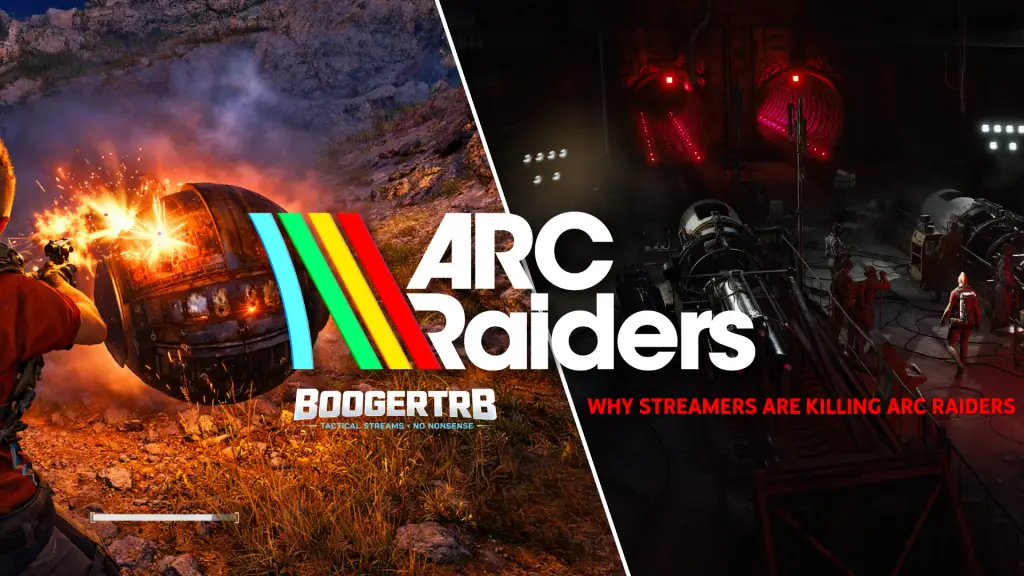
Streamers Killed ARC Raiders: A Modern Gaming Tragedy
There was a time when discovering a game felt like stepping into uncharted territory. You didn’t have a roadmap. You didn’t have a meta. You didn’t have a guy on YouTube telling you the “best loadout in 10 minutes or less.” You just had curiosity, confusion, and the thrill of figuring things out.
That’s the world ARC Raiders should have lived in.
Instead, it walked straight into the spotlight—and got dissected before it even had a chance to breathe.
This is why I believe streamers didn’t just influence ARC Raiders… they helped kill it.
The Hype Machine Turned Execution Chamber
Streamers today are not just players—they’re accelerants. The moment a game like ARC Raiders appears, it doesn’t get explored. It gets consumed.
Mass exposure sounds like a dream for developers, but there’s a catch. When thousands of viewers watch a handful of creators play early builds, the game gets judged instantly, publicly, and often unfairly.
There’s no patience anymore. No slow burn.
A streamer plays for a few hours, runs into unfinished mechanics, unclear systems, or balance issues—and suddenly those rough edges define the entire game. Chat reacts. Clips spread. Opinions calcify.
Before most players even touch the game, the verdict is already stamped:
“Mid.”
“Dead.”
“Not worth it.”
And just like that, ARC Raiders goes from promising to “already failed” in the eyes of the crowd.
The Meta Virus
One of the biggest casualties in modern gaming is discovery.
Streamers, whether intentionally or not, industrialize optimization. They turn exploration into efficiency. Within days—sometimes hours—of gameplay, the “best way to play” gets established.
Weapons, strategies, routes, builds—it all gets solved.
ARC Raiders is designed to be atmospheric, tactical, and unpredictable. But when streamers get involved early, unpredictability disappears. Everything becomes calculated.
Instead of:
- experimenting
- adapting
- surviving
Players end up:
- copying
- repeating
- min-maxing
The result? A game that should feel alive suddenly feels solved.
And once a game feels solved, it feels smaller.
Entertainment Over Experience
Streamers don’t play games the way most people do.
They play for content.
That means faster pacing, louder reactions, riskier behavior, and a constant need to entertain. Subtlety doesn’t perform well. Tension doesn’t clip easily. Slow moments don’t trend.
So what happens to a game like ARC Raiders, which thrives on tension, atmosphere, and buildup?
It gets distorted.
Moments meant to feel intense become rushed. Systems meant to be learned gradually get brute-forced. The game’s identity bends under the pressure of being “watchable.”
Viewers don’t see the game as it’s meant to be experienced. They see a version optimized for engagement.
And then they judge the game based on that version.
The Echo Chamber Effect
Streamers don’t exist in isolation. They exist in a network.
One big creator says something negative, and suddenly smaller creators echo it. Chat reinforces it. Social media amplifies it.
What starts as one opinion becomes consensus.
It doesn’t matter if that opinion is based on limited playtime or early builds. It spreads anyway.
ARC Raiders didn’t just face criticism—it faced synchronized criticism.
And once that wave hits, it’s incredibly hard to recover.
Because perception in gaming is everything.
Early Access Is a Double-Edged Sword
Letting streamers access a game early feels like smart marketing. It builds awareness. It generates buzz.
But it also exposes the game in its most vulnerable state.
Early builds are not finished products. They’re incomplete, unpolished, and often missing key features. They’re meant to be tested, not judged.
But streamers don’t treat them like test environments.
They treat them like releases.
And audiences do the same.
So instead of:
“this looks promising”
You get:
“this looks broken”
That shift in framing is devastating.
ARC Raiders didn’t get the benefit of evolving quietly. It evolved under a microscope, with every flaw magnified.
The Death of First Impressions
First impressions used to belong to players.
Now they belong to viewers.
Before most people even install a game, they’ve already watched hours of it. They’ve seen the gameplay loop. They’ve seen the weapons. They’ve seen the environments.
Nothing feels new anymore.
And when nothing feels new, motivation drops.
Why jump into ARC Raiders if you feel like you’ve already experienced it?
That’s the hidden cost of streamer-driven exposure. It replaces curiosity with familiarity.
And familiarity kills excitement.
Negativity Travels Faster Than Nuance
Balanced opinions don’t go viral.
Extreme ones do.
“This game has potential but needs work” doesn’t get clicks.
“This game is dead on arrival” does.
Streamers know this, whether consciously or subconsciously. Strong takes drive engagement. Engagement drives growth.
So the tone shifts.
Criticism becomes sharper. Praise becomes louder. Everything gets exaggerated.
ARC Raiders didn’t just get reviewed—it got dramatized.
And drama spreads fast.
Community Perception Becomes Reality
Games don’t live or die purely on mechanics.
They live and die on perception.
If enough people believe a game is failing, they stop playing it. If they stop playing it, the player base shrinks. If the player base shrinks, the game struggles.
It becomes a self-fulfilling prophecy.
Streamers play a massive role in shaping that perception. Their reach is enormous. Their influence is immediate.
When they collectively move on, audiences follow.
ARC Raiders didn’t just lose attention—it lost momentum.
And in today’s gaming landscape, momentum is everything.
The Speed Problem
Modern content cycles are brutally fast.
A game has maybe a week—if it’s lucky—to make an impact.
Streamers jump from game to game, chasing what’s new, what’s trending, what’s pulling views.
ARC Raiders needed time.
Time to grow.
Time to be understood.
Time to find its audience.
It didn’t get that time.
It got a spotlight, a surge of attention, and then silence.
And silence, in the streaming world, is deadly.
It’s Not Entirely Their Fault
To be fair, streamers aren’t villains.
They’re part of a system.
They respond to incentives—views, engagement, growth. They play what works. They say what resonates. They move when the audience moves.
The real issue is the ecosystem itself.
A system where:
- speed matters more than depth
- reaction matters more than reflection
- exposure matters more than experience
In that system, a game like ARC Raiders is at a disadvantage.
Because it isn’t built for instant gratification.
It’s built for immersion.
And immersion doesn’t always translate through a screen.
What Could Have Been
Imagine a different path.
No early streamer access.
No immediate meta.
No pre-formed opinions.
Players drop into ARC Raiders blind.
They learn together.
They experiment.
They fail and adapt.
The world feels unknown. The threats feel real. The systems unfold naturally.
That version of the game hits differently.
That version has a chance to grow organically.
But that’s not the version we got.
Conclusion: A Game Consumed Too Quickly
ARC Raiders didn’t fail because it lacked potential.
It struggled because it was consumed too quickly, judged too early, and defined by voices that experienced only a slice of what it could become.
Streamers didn’t swing a single decisive blow.
They applied constant pressure—fast, loud, and influential.
And in today’s gaming ecosystem, that’s often enough.
The tragedy isn’t just that ARC Raiders stumbled.
It’s that it never really got the chance to stand on its own.